Standing seam metal or laminated shingle when tall firs hang over your roof
Both are good roofs, but they behave differently under needles, cones and a wet Northwest winter.
October 16, 2026 · 4 min read
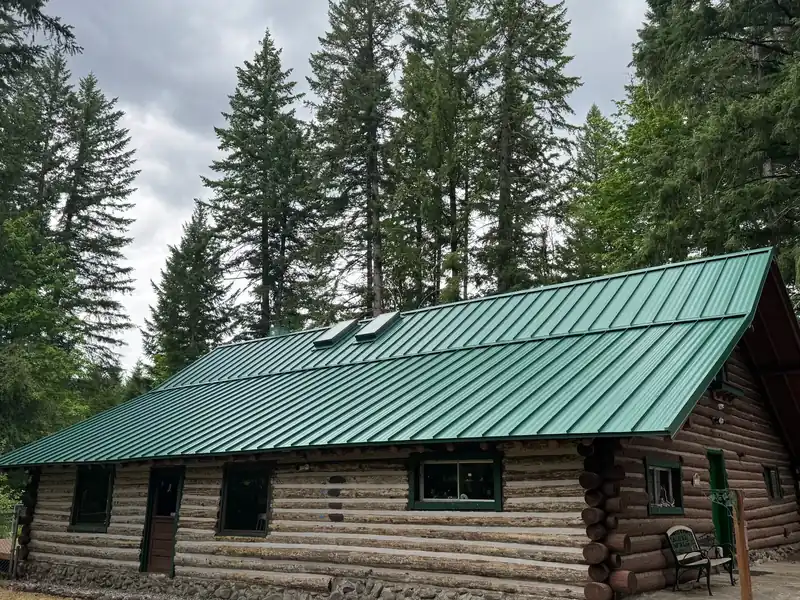
Two roofs Gregg Roofing installs often
Gregg Roofing, LLC has been roofing out of Camas since 1944, and most homeowners we talk to around Camas, Washougal and Vancouver end up choosing between two systems: laminated architectural shingle and standing seam metal. Both are solid choices. They just behave differently when a few big firs are leaning over the house, and that difference is worth thinking through before you sign anything.
A laminated architectural shingle is an asphalt shingle built from layered pieces, which gives it a thicker, dimensional look than the flat shingles of a few decades ago. Standing seam metal is a system of long panels that run from the ridge down to the eave and lock together at raised seams, with the fasteners hidden underneath. One roof is thousands of small overlapping pieces. The other is a handful of long continuous runs. Nearly everything else in this comparison comes back to that.
What the trees do to a roof
Fir needles, cones and small twigs come down all year. On a shingle roof that debris settles into valleys, behind chimneys and along the lower courses, where it holds water against the surface. In a wet Northwest winter, damp debris is also where moss likes to start. Any roof under trees needs its valleys and gutters cleared more often than a roof in an open field, whatever it's made of.
A metal panel has a smooth, hard surface, and falling needles and cones tend to slide off it once rain or a little wind gets behind them. A shingle's granule surface gives debris something to grab. That doesn't make metal maintenance free, because debris still collects in valleys and at the gutter line and still has to be cleared. But there is usually less of it sitting on the main field of the roof, and that matters when you're deciding how much upkeep you want.
Snow and the occasional heavy winter
Snow doesn't arrive often in the Camas and Vancouver area, but when it does it can be wet and heavy. Metal sheds snow readily. That's a benefit, and it's also something to plan for, because snow that lets go all at once can land on a walkway, a deck or a parked car. Shingles hold snow longer and let it melt off more gradually.
Ask your estimator where the snow would go from each roof edge, and whether the roof should have snow guards over places where people walk or park. That's a design question for the site visit, not something to guess at from a brochure.
How each one looks
Standing seam has clean, straight lines and suits cabins, lodges, timber-frame structures and outbuildings as well as modern houses. Much of the standing seam work Gregg Roofing does is on cabins and homes set among tall conifers, which is exactly where the look works well. Laminated shingle is softer and more textured, comes in a wide range of colors, and blends into a traditional neighborhood.
One customer who chose metal wrote in a Google review that he absolutely loves how it looks and that no one in his neighborhood has anything like it. If you want the house to stand apart, that's the upside. If you'd rather it match the street, or your neighborhood has rules about roofing, shingle is the easier fit. Check with your association before you fall for a color.
Install time and disruption
That same customer collected six estimates for his roof and mentioned that because it was metal, the job took about two weeks to complete. Standing seam is detail work. Panels are measured, cut and formed to your roof, and the flashings at every edge, valley and penetration are where the roof either lasts or doesn't.
Shingle installation generally moves faster, but the real schedule depends on roof size, how many layers have to come off, the weather, and what the decking looks like once the old roof is gone. Don't hold anyone to a day count from a blog post. Ask your estimator for a realistic window and what happens if a rainy week gets in the way.
Questions worth asking every roofer
- How many standing seam roofs have you installed, and who on your crew does the metal work? The six-estimate customer said some of the companies he talked to seemed unsure about doing metal at all.
- Which panel or shingle line are you proposing, and who makes it? Gregg Roofing works with product lines such as CertainTeed, Owens Corning, IKO and Malarkey for shingle, and Custom-Bilt Metals and Taylor Metal Products for metal.
- How will valleys, chimneys, skylights and pipe penetrations be flashed?
- What's the plan for needles, cones and snow around my particular trees?
- What does the written estimate say about materials, cleanup and what's included?
Picking between them
There isn't one right answer for every house. Metal makes sense when you want a distinctive look and less debris sitting on the roof, and you're comfortable with a longer install. Shingle makes sense when you want a traditional appearance and a quicker job. The best way to decide is to have an estimator stand in your yard, look at the trees and the roof pitch, and price both options for the same house.
Gregg Roofing's estimators have been in the trade for more than 20 years, and they'd rather teach you what to look for than just collect a signature. The estimate is free. Call the Camas office at (360) 834-3902 and ask for both options on the same visit.
Gregg Roofing, LLC, (360) 834-3902
Call (360) 834-3902More articles
Why moss on a Northwest roof is worth dealing with early
A cleaning is cheap compared with replacing rotted sheathing, and the gap between the two can be a few months.
Granules in your gutters and what they say about your shingles
A gritty layer at the bottom of a downspout is worth a closer look, especially on a roof that isn't very old.